
- Line-item pricing — bar stock, cycle time, setup, tooling, and finishing broken out, so you see where the money goes.
- Setup is fixed per batch — the first part is the most expensive; volume is the divisor.
- Turning is fast in cycle — material and setup dominate at low volume, material dominates at high volume.
- MOQ 1 piece, lead times roughly 3 / 7 / 30 days.
What does a CNC machining service actually cost you?
The price of a machining service is built from five lines — bar stock, cycle time, setup and programming, tooling, and finishing — divided by the quantity you order. A single number hides all of that; a line-item quote shows it. For you, the line items matter more than the total, because each one is a place where a bad shop hides a corner or a good shop shows you where the money goes.
Treat a quote that arrives as one number as an invitation to ask for the breakdown. If the shop cannot produce the breakdown, it never did the math, and it is pricing your risk, not your part.
Each line also moves on its own driver, and knowing the drivers is what lets you read a quote instead of just reading it. Bar stock moves with alloy and bar diameter; cycle time moves with geometry and tolerance; setup is fixed per batch; tooling moves with how unusual the features are; finishing moves with how many steps the part needs after machining. When a quote changes, the driver that moved tells you why, and whether the change is real or padding.
How does setup and programming drive the low-volume premium?
Setup and programming are fixed costs per batch: the CAM work, the tool load, the offset dial-in, and the first-article check happen once, whether you order one part or ten thousand. At low volume, that fixed cost sits on top of a handful of parts, so the per-part price looks high. At volume, the same setup spreads thin and nearly disappears.
This is why the first part of any run is always the most expensive one. If you understand this, you stop being surprised by the prototype price, and start using quantity deliberately — validate the design on one part, then release the volume where setup amortizes.
How does cycle time drive the high-volume price?
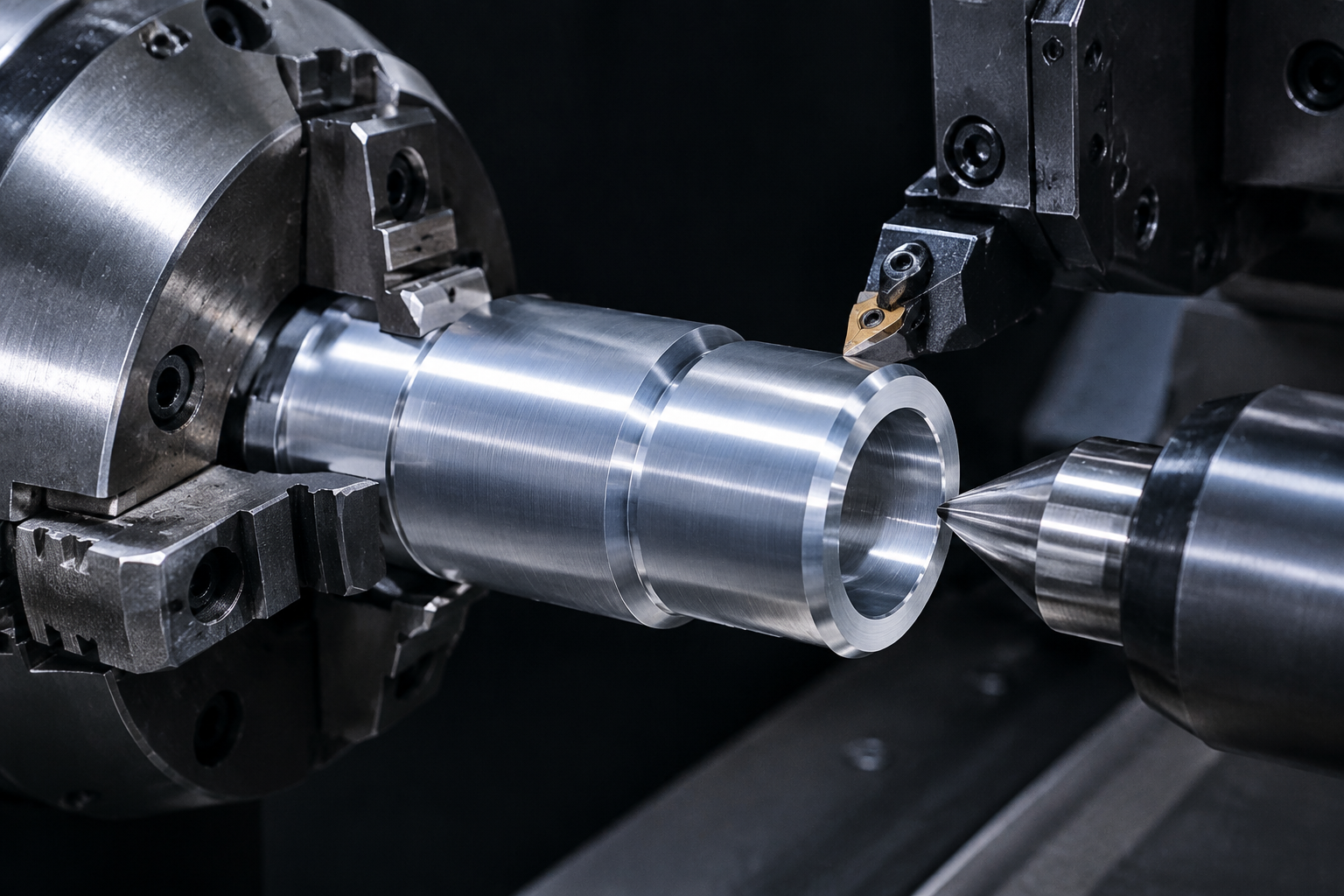
Turning removes material with a continuous cut, so a turned part is cheap in cycle time — seconds, not minutes. At high volume, the per-part cost collapses toward raw material plus a short cycle, and a second saved per part becomes real money across a run. Milling and mill-turn are slower per feature, which is why complex geometry costs more even when the material is cheap.
The TCO lesson runs in both directions: cycle time wins the visible price at volume, but a fast cycle also accumulates scrap quickly if the process drifts. A service that is cheap on cycle and silent on in-process inspection has traded a fast cut for a fast pile of bad parts.
How does tooling recur on re-orders?
Tooling — inserts, drills, live-tooling holders, fixtures — is a one-off cost that can quietly become a recurring one. A special insert or a custom fixture bought for the first run may be charged again on the re-order if the shop does not separate the two. An honest quote lists tooling as its own line, so you know whether a cost is one-time or repeat.
Ask on the first order: which of these lines recur, and which are amortized once? The answer tells you whether the re-order price you were quoted is real or a teaser.
How does finishing bundle into the service?
Finishing is where a machining service either becomes a complete supply or a surprise. Anodizing, plating, powder coating, heat treatment, deburring, and polishing all add process steps, and, in the case of surface finishing, push a part into the longer lead-time tier. A service that bundles these through qualified partners gives you finished parts on one invoice and one accountable supplier, instead of a machined blank you must finish elsewhere.
Honest scope note: in-house ovens reach 500 °C, which covers aluminum and low-temperature steel stress relief. Titanium stress relief above that temperature is outsourced to a qualified partner — stated up front, not discovered after the fact.
Which machining services run in-house?
Having a process in-house means one accountable supplier and a shorter lead time, because the part does not leave the building between operations.
| Service | Capacity | Max workpiece |
|---|---|---|
| CNC turning | 25+ lathes (incl. Swiss-type and mill-turn) | Ø720 × 1280 mm |
| 3-axis milling | 50+ centers | 1300 × 700 × 600 mm |
| 4-axis milling | 20+ centers | |
| 5-axis milling | 20+ centers | |
| Precision grinding | 7+ (surface / centerless / cylindrical) | ±0.002 mm finishes |
When every operation on a part runs under one roof, the price you are quoted covers the work that actually happens there, not a chain of subcontracts, each with its own margin and its own queue. The in-house service list is therefore not just a capability statement; it is a cost statement. Fewer handoffs mean fewer markups and a shorter path from bar stock to finished part.
How do lead time and TCO interact?
Lead time is a cost driver even though it never appears as a line item. A rush job forces a shop to break its schedule, slot your work ahead of a planned batch, and sometimes pay a premium for expedited material or overtime. An honest service tells you what acceleration costs rather than hiding it in the price and surprising you later.
The practical windows are roughly 3, 7, or 30 days depending on complexity and process steps. The decision rule is the same one that governs every cost on this page: pay for speed only where speed returns more than it costs. A part that unblocks a launch or restarts a stopped line is worth the premium; a batch accelerated "just to be safe" usually is not.
What service level should you hold a shop to?

Hold a machining service to the same standard you would hold any supplier whose failure lands on your production line. The minimum bar is specific and checkable, not a slogan.
- Line-item quote — a breakdown, not a single number.
- Tolerance stated in writing — with the CMM report to prove it.
- First-article inspection — one part measured before the batch runs.
- In-process checks — dimensions verified mid-run, not only at the end.
- Material traceability — a mill certificate and XRF verification for the alloy you ordered.
A service that clears all five is buying you the $1 fix at the front of the chain. A service that deflects on any of them is quietly moving cost onto your invoice.
How do you make quotes comparable across suppliers?
Two suppliers can only give you comparable numbers if both are quoting the same scope. The single highest-leverage habit in machining procurement is to send the same specification to every shop — same material grade, same tolerances, same finishing, same quantity, same inspection requirements. When the scope is identical, the price differences are real differences in capability and overhead, and you can act on them. When the scope is vague, the differences are noise, and acting on noise is how buyers get burned.
How does material choice change machining cost?
The material you specify is a machining decision as much as a design one. A free-machining grade — 303 stainless, 12L14 steel, 6061 aluminum — cuts fast and cleanly, so cycle time drops and tool life stretches. A harder or gummier alloy — 316 stainless, 4140, titanium — is slower to cut, wears inserts faster, and costs more per part even when the bar price is similar. The machinability gap is why two parts that look identical can price differently by material alone.
Material also sets the scrap risk. A gummy alloy can smear and work-harden if the speeds and feeds are wrong, and the resulting scrap accumulates at the speed of the cycle. The shop that knows your alloy's cutting parameters is pricing the job it will actually run, not the job it hopes to run.
How do secondary operations change the total?
Deburring, heat treatment, plating, and anodizing are the operations that turn a machined blank into a finished part, and they are where the quote either stays honest or quietly inflates. Each secondary operation is a step, and each step adds time, cost, and a chance for damage in handling. A quote that lists them separately shows you what is included; a quote that buries them under one number leaves you guessing.
Some secondary operations run in-house and some through qualified partners. The honest answer names which is which, because an outsourced step is a handoff, and a handoff is where lead time and accountability get added. Ask which secondaries are bundled, which are in-house, and which are subcontracted, and the quote stops being a mystery.
How does programming quality affect cost and repeatability?
Programming is where a cheap part and a repeatable part part ways. Good CAM work picks the right tools, orders the operations so the part does not deflect, and writes a program that produces the same geometry on the re-order as on the first run. Bad programming shows up as chatter, extra finishing passes, or a part that measures differently every time it runs.
For you, programming quality is invisible until it is not — you feel it in the first article and the re-order. A shop that keeps programs, tools, and setups documented per part is buying you repeatability: the tenth order runs like the first, and the price you were quoted holds because the process did not change underneath it.
What should a line-item quote actually contain?
A line-item quote is the difference between a price and a proposal. At minimum it should break out bar stock, cycle time, setup and programming, tooling, and finishing, with quantity and tolerance stated beside each line. With that in hand, two quotes become comparable: you can see whether the difference is in the material, the cycle, or a finishing step one supplier forgot to include.
A quote that cannot produce the breakdown has not done the math, and it is pricing your risk rather than your part. When you hold every supplier to the same line items, the price differences that remain are real differences in capability and overhead, which is the only kind of difference worth acting on.
What this shop actually runs
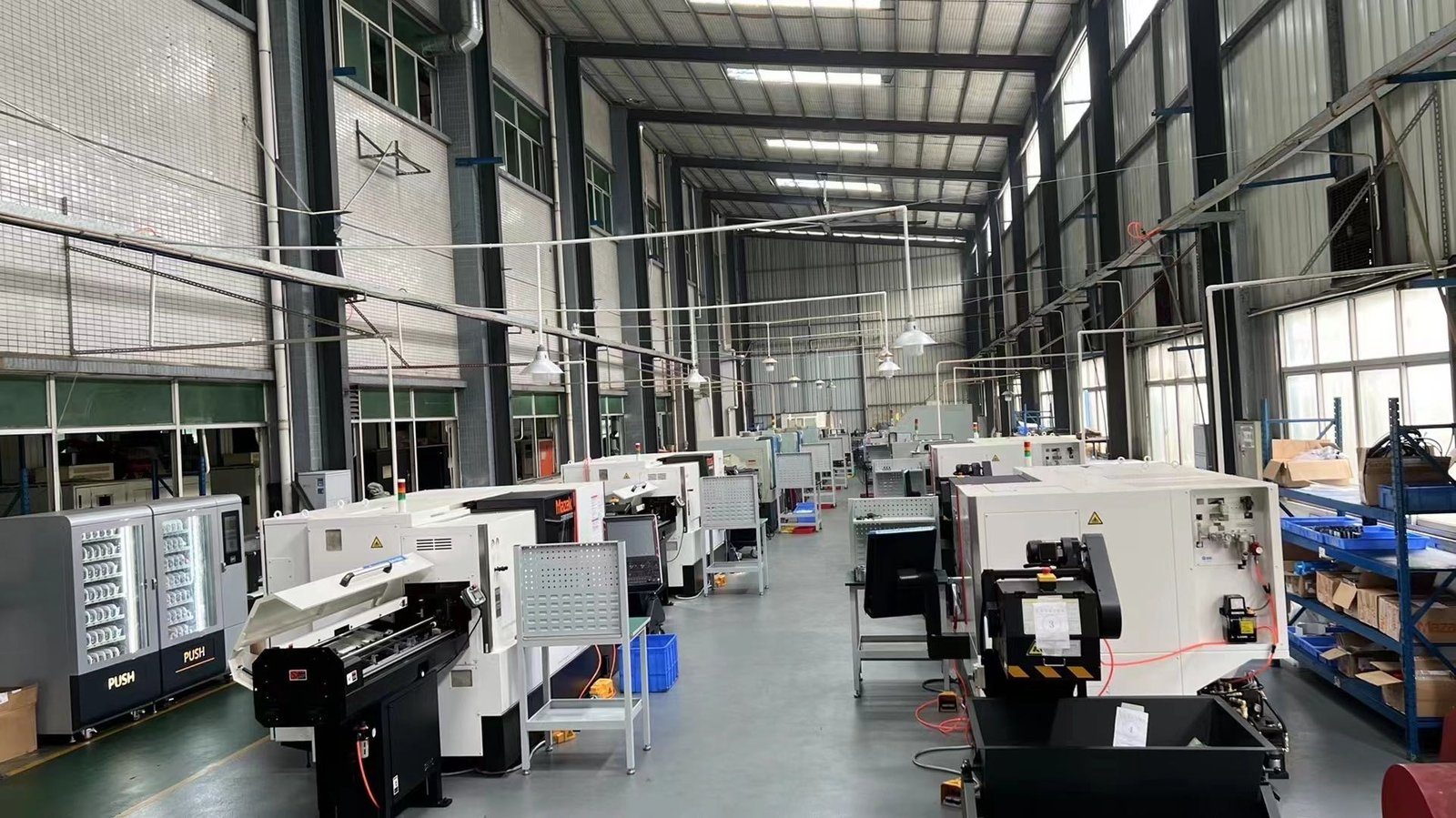
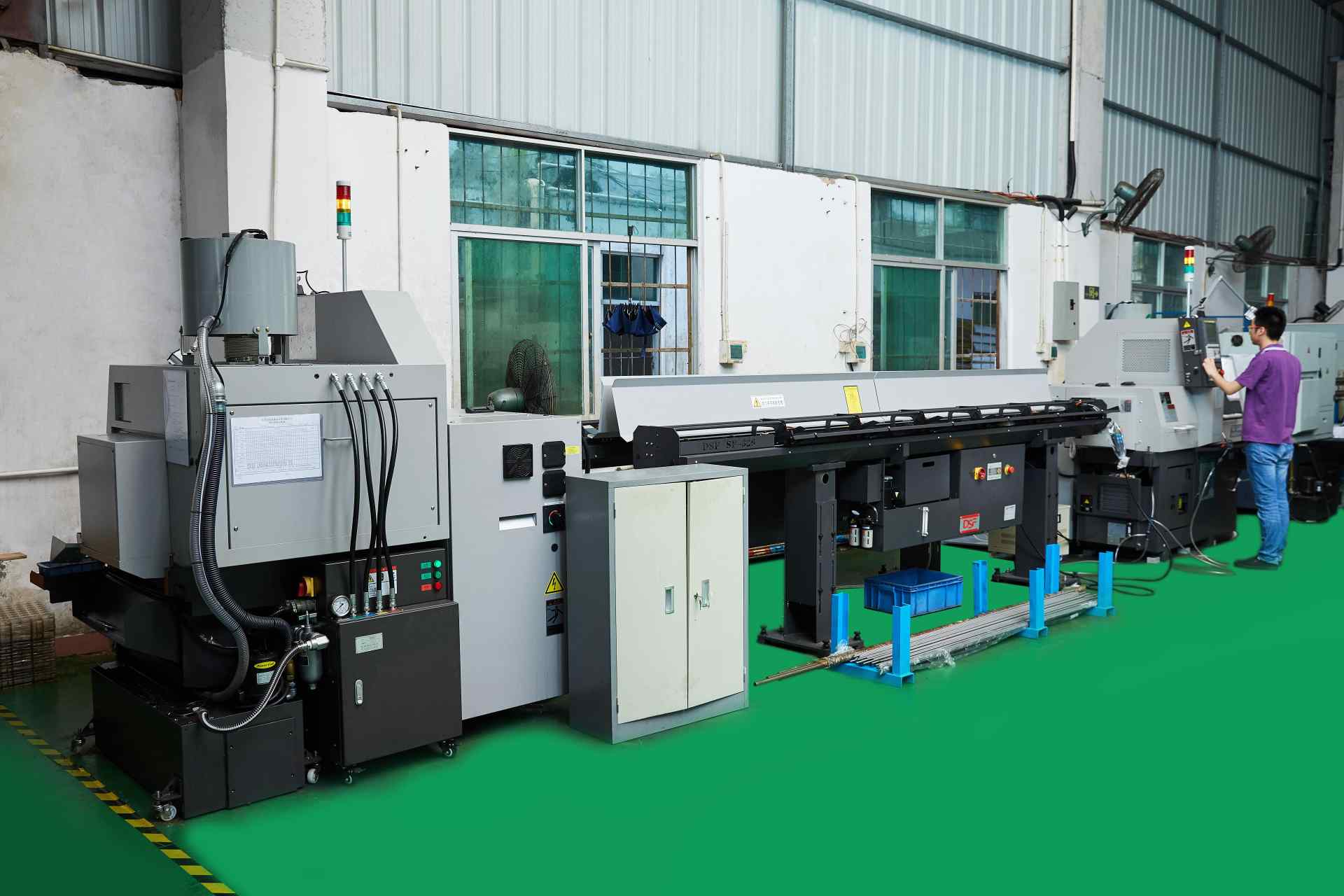
If you ask for capability evidence, you deserve a specific answer. This facility operates 100+ CNC machines across 6,800 m2 in Dongguan, China, staffed by 100+ people. The machines, listed by category:
- 5-axis machining centres (10+) - Mazak VARIAXIS I-600 (510/910/510 mm travel, 12,000 rpm, 22 kW, 71.6 N·m, 30-tool BT40) and Mazak INTEGREX I-250H S (B-axis 0.0001°, 24 kW, 124 N·m, 38-tool HSK-A63). Set up for compound-angle parts, single-setup multi-face prismatic work, and aerospace fittings where datum transfer loss is unacceptable.
- 3-axis / 4-axis machining centres (50+) - Brother SPEEDIO S500Z2N / S700Z2N (10,000 rpm, 14/21-tool ATC, 0.7 s tool-to-tool, Z-axis 2.2 G) and Mazak VCE-430A L / VCE-570C L (10,000 rpm, 118 N·m, 24-tool ATC). Set up for prismatic parts, plates, brackets, housings.
- Swiss-type turning centres (10+) - Citizen Cincom A20-3F7 (Φ20 mm, 10,000 rpm), TSUGAMI B0206-III / B0205-III (Φ20 mm, 0.1 µm), STAR SR-32JII / SR-32J Type N (Φ32 mm, 8,000 rpm). Set up for long, slender rotational parts at ±0.002 mm.
- CNC turning centres (20+) - HEADMAN T70M/1250 (720 mm swing, 117 mm bore, 3,000 rpm, BMT75 12-station turret). Set up for shafts, bushings, flanges up to ±0.002 mm.
- Wire EDM (5+) - Sodick AQ535L (550/350/300 mm travel, ±20° taper, 800 kg workpiece). Set up for hardened tool steel, internal splines, sharp internal corners that milling cannot reach.
- Inspection: Hexagon CMM + 20+ gauges - Hexagon CMM for coordinate measurement, plus vision system, profilometer, hardness tester, coating thickness gauge, XRF for material verification. The 10:1 rule (gauge 10x more accurate than the band) is applied to every feature.
- Machine highlights - VARIAXIS I-600: one-setup multi-face 5-axis + MAZA-CHECK auto-calibration; INTEGREX I-250H S: DONE-IN-ONE mill-turn, B-axis 0.0001° + Ai thermal shield; SPEEDIO S500Z2N / S700Z2N: Z-axis 2.2 G + 0.7 s ATC; Swiss-type: guide-bush switchable + 0.1 µm resolution.
Tolerance bands: ±0.003 mm milled, ±0.002 mm turned, ±0.002 mm ground or wire-cut. Capability indices: Ppk >= 1.67 at the initial study; Cpk >= 1.33 ongoing in production.
Certifications: ISO 9001:2015 (116024/A/0001/UK/En) · IATF 16949:2016 (131941/A/0001/SM/En, design clause 8.3 excluded) · ISO 14001:2015 (116024/B/0001/UK/En), held by Dongguan Zhuohang Ltd (USCC 91441900MA4UWT6X39, since 2005).
Service area: we supply Austria, Belgium, the Czech Republic, Denmark, France, Germany, Greece, Hungary, Ireland, Italy, the Netherlands, Spain, Sweden and the United Kingdom in Europe; Brazil, Canada, Mexico and the United States in the Americas; China, Israel, Japan, Singapore and Sri Lanka in Asia; Australia and New Zealand in Oceania; and South Africa in Africa, with worldwide delivery from China.
Contact: Felipe Iglesias, [email protected], +86 13126536955.
Get a line-item quote you can actually compare
Send your drawing to [email protected] or call +86 13126536955 for a breakdown that shows where the money goes.
Frequently Asked Questions
How is a CNC machining service priced?
By the line items the cost is actually built from: bar stock, cycle time, setup and programming, tooling, and finishing, divided by volume. There is no flat rate, because each line moves with material, tolerance, and quantity.
What is your minimum order quantity?
Our MOQ is 1 piece. We run single-part prototypes and low-volume jobs alongside bar-fed production, so setup cost is amortized across the quantity you actually need rather than a forced minimum.
What tolerances can you hold?
In short, ±0.002 mm (turning) / ±0.003 mm (milling) for CNC turning and milling, and ±0.002 mm for precision grinding. Critical dimensions are verified on Hexagon CMMs, with process capability of Ppk ≥ 1.67 at the initial study on key characteristics and Cpk ≥ 1.33 on general characteristics.
What materials do you machine?
Aluminum, stainless steel, carbon and alloy steel, brass, copper, titanium, and magnesium, plus engineering plastics. Incoming bar stock is XRF-checked against the mill certificate before it reaches a machine.
What are your lead times?
Roughly 3, 7, or 30 days depending on part complexity and the number of process steps. Simple parts ship in about 3 days; parts with surface finishing or many operations fall into the longer 30-day tier.
Can you bundle surface finishing and heat treatment?
Yes — anodizing, plating, powder coating, painting, brushing, polishing, and heat treatment are bundled through qualified partners so you receive finished parts. In-house ovens reach 500 °C; titanium stress relief above that is outsourced.
Do you provide inspection reports?
Yes. CMM dimensional reports, SPC charts, and material certificates ship with your parts. For new programs a first-article inspection report is provided before production, so you sign off on a measured part before the batch runs.
How do I get a quote?
Send your STEP, IGES, or toleranced 2D drawing to [email protected]. We return a design-for-manufacturing review and a line-item quote, flagging any tolerance or process issues before you commit.
Continue reading: 3 Axis CNC Turning Service · 4 Axis CNC Turning Service · 5 Axis CNC Turning Service
Standards referenced on this page
- ASTM A582/A582M-12 — Standard Specification for Free-Machining Stainless Steel Bars
- ASTM B348/B348M-21 — Standard Specification for Titanium and Titanium Alloy Bars and Billets
- ISO 9001 — Quality management systems — Requirements