
A delivery date from a CNC turning shop is really a chain of small schedules, and the machining is often the shortest link in it. A simple part can be turned in minutes, but the order does not ship when the cutting finishes - it ships when the bar has arrived, the queue has cleared, the finishing batch has run, the inspection has passed, and the freight has moved. Buyers who understand the chain can estimate a realistic date and, more importantly, protect it.
Keep this working rule in mind: with a complete drawing and a stocked bar grade, a simple part at prototype quantity should be ready at the factory in about one to three weeks in 2026, and a part with secondary operations and finishing more like three to six weeks, before transit. The sections below show where those weeks come from, which links you control, and how to hold a schedule together when a link slips.
Which part of the lead time belongs to you?
The uncomfortable truth is that a meaningful share of every turning lead time is written by the buyer, not the shop. It is the days a drawing sits in review, the round trips when a material grade is missing or a tolerance is undefined, the wait while a quote is compared internally, and the delay between quote approval and purchase order. None of that time touches a machine, and all of it is on your calendar.
The fastest way to shorten a lead time is therefore to remove your own latency. Approve the quote when you receive it, or say why. Freeze the drawing before you send it out for quotes, not after the first article is cut. Answer the supplier's technical questions the same day they arrive. A shop cannot start its schedule until you finish yours, and the buyers who understand that get dates counted from an earlier starting point.
Then treat the commercial step as part of the plan. The order is not placed when the quote is accepted in a phone call; it is placed when the purchase order is issued, the material is confirmed, and the schedule is agreed in writing. Each of those steps has a day attached, and a buyer who sequences them quickly is already ahead of one who lets them drift.
What happens between order confirmation and the first chip?
Once the order is confirmed, four things must happen before any metal is cut, and each has its own clock. The bar must be secured - from stock or from a distributor. The job must enter the machine queue, whose depth depends on what else the shop is running that week. The program must be prepared or retrieved from the previous run. And the first article must be proven before the quantity follows.
The queue is the least visible and most influential of the four. A shop with open capacity starts your job immediately; a full floor schedules it behind the current work, and no amount of urgency moves a machine that is already cutting another customer's order. This is why a confirmed start date matters more than a promised delivery date: the start date tells you where you actually stand in the queue.
Ask the supplier to name both. A shop that commits to a start date is scheduling your job into the floor; one that offers only a ship date is holding a buffer you will not see until it is used. The honest schedule is the sum of the material wait, the queue position, the machining, the finishing, and the inspection - and each of those should be visible in the plan you agree to.
How do you know a promised date is real?
A delivery date is only as real as the plan behind it. Ask for the plan in milestones rather than a single promise: the date the bar is expected, the date the job enters the machine, the date the first article is ready for review, and the date the parts reach inspection. A supplier that can name those intermediate dates has a schedule; one that can name only a ship date has a hope.
Read the milestones against the drivers. If the bar is a specialty alloy coming from the mill, the material date should reflect a week or more of sourcing. If the part needs finishing, there should be a gap between the machining date and the ship date for the batch cycle. If every milestone sits tightly packed with no slack at all, the plan has no room for reality, and reality will find it anyway.
Then hold the supplier to the milestones, not just the end date. When the material date slips, the schedule has already told you the ship date is at risk - and you can act while there is still time, either by expediting the bar, adjusting the quantity, or warning your own downstream schedule. A schedule with visible milestones is an early-warning system; a single promised date is a surprise generator.
When do drawings extend the calendar before cutting starts?
Drawings extend the calendar in two ways. The first is ambiguity: a drawing with no material grade, no finish specification, or critical diameters left open forces the shop to ask, wait, and price around the unknown. The second is complexity: a drawing that demands second-operation features, tight tolerances everywhere, or slender geometry that must be cut slowly is a drawing that quietly adds days to the machining span.
Review the drawing for schedule content before you send it. Count the features the lathe cannot reach in its primary pass - cross holes at angles, milled flats, keyways - and ask whether each one is worth its queue. Look at the tolerance density: every diameter held to a precision band adds measurement and documentation time, and precision turning's ±0.002 mm and grinding's ±0.002 mm bands - the numbers the quality system publishes - with capability targets such as Ppk ≥ 1.67 at the initial study on key characteristics and Cpk ≥ 1.33 on general characteristics. Capability is reported per characteristic: every report names the feature, its tolerance band, the sample size, the sigma method, and the study window., are earned with inspection that the calendar must absorb.
Freeze the drawing at the quoting stage and again at order. A revision after the order is placed does not just change the geometry - it restarts the programming, may reorder the bar, and lands on top of a queue already scheduled around the old drawing. Every revision after the first article is paid for twice, in money and in calendar, and the buyers who freeze drawings early are the ones whose dates hold.
Where do batches and outside processes hide days?
Finishing and outside processes hide more days than any other part of the schedule, because they run on their own calendars. Anodize, passivation, and plating collect parts into lots before a tank runs, so a part that finishes machining on a Monday may not see the tank until the batch fills. Hard anodize and any thickness-verified coating add verification time on top of the batch wait.
Outside processes add another layer. Plating, heat treatment, or specialty coatings often go to a shop that batches work for several customers, and that shop's queue is outside the turning supplier's control. Heat treatment also reorders the machining sequence - a hardened part needs rough turning, treatment, and a finishing pass on the critical surfaces - which inserts a queue in the middle of the job rather than at the end.
Ask two questions at quoting: which finishing steps run in-house, and which go outside? The answers tell you where the schedule risk sits. Then ask the outside process for its own lead time, because the turning supplier's estimate is only as good as the finisher's promise. A finish that is cosmetic carries one calendar; a verified engineering coating carries another, and the drawing should say which one the schedule must include.
How do prototypes and production runs behave differently?
A prototype and its production follow-on are two schedules wearing the same part number. The prototype races from order to first article and inspection, because its job is to prove the drawing and the process. The production run then starts from a different place: it needs bar for the full quantity, a re-release of the proven setup, and inspection of the entire lot before shipment.
That is why the production date must count from prototype approval, not from the original order date. A supplier that quotes both together usually prices and schedules the run on the assumption that the prototype is approved as drawn - and every prototype iteration pushes the production date with it. Buyers who treat the two as one promise discover the slip only when the production date arrives and the parts are not there.
Plan an approval gate between them and put it in the schedule. When the prototype clears inspection and the drawing is frozen, the production run starts its own clock with its own material and capacity plan. Sequencing the two as separate milestones keeps each schedule honest, and it gives the buyer a decision point where the design can still change without re-scheduling a production run that has not started.
What should the shipping leg add to the plan?
Freight is the schedule line buyers misjudge most, because it looks simple and is not. Air freight from southern China reaches most destinations in days when customs is routine. Ocean freight takes weeks, and the voyage is only part of it - port handling, customs clearance, and inland delivery at both ends routinely add more time than the sailing itself. The difference between "ready at factory" and "on your dock" can be measured in weeks, and confusing the two breaks more promises than machining ever does.
Match the mode to the purpose. A first article should fly, because the value of closing the design loop in days exceeds the airfreight premium. Repeat production should go by sea on a regular cadence, because the economics are right once inventory covers the transit window. The mistake is using ocean freight for a first article and then waiting weeks to learn that the drawing needs a change.
Confirm the Incoterm in the same conversation as the date. Under EXW or FOB you control the freight and can choose the speed; under DDP the supplier controls it, and the delivery date should state which leg it includes. Ask the question in writing, because the number in the email is only meaningful if everyone agrees what it means.
How do you lock a schedule that survives?
A schedule survives when it is built from the chain rather than from a hope. Lay out the links - drawing freeze, bar arrival, queue start, machining, finishing, inspection, freight - and give each one a realistic duration with a little slack at the points that have no recovery. Material sourcing can slip and finishing batches can wait; a plan that assumes every link lands on its best day is a plan for lateness.
Protect the schedule with information, because the shop can only hold a date it can see coming. Give a forecast for repeat work so bar and capacity can be reserved ahead of firm releases. Keep one technical contact on each side so a question raised in Dongguan gets an answer the same day. And when a milestone slips, learn about it at the milestone, not at the ship date - which is exactly what a milestone-based schedule exists to give you.
Finally, treat the lead time as a shared plan rather than a supplier's promise. The buyers whose CNC Turning Service Parts arrive on the date in the email are the ones who froze their drawings, answered their questions fast, scheduled the prototype and the run as separate gates, and picked the freight mode that matched the purpose. A turning lead time is not a number a shop gives you; it is a plan both sides execute, and the plan is only as good as the discipline on both ends.
What this shop actually runs
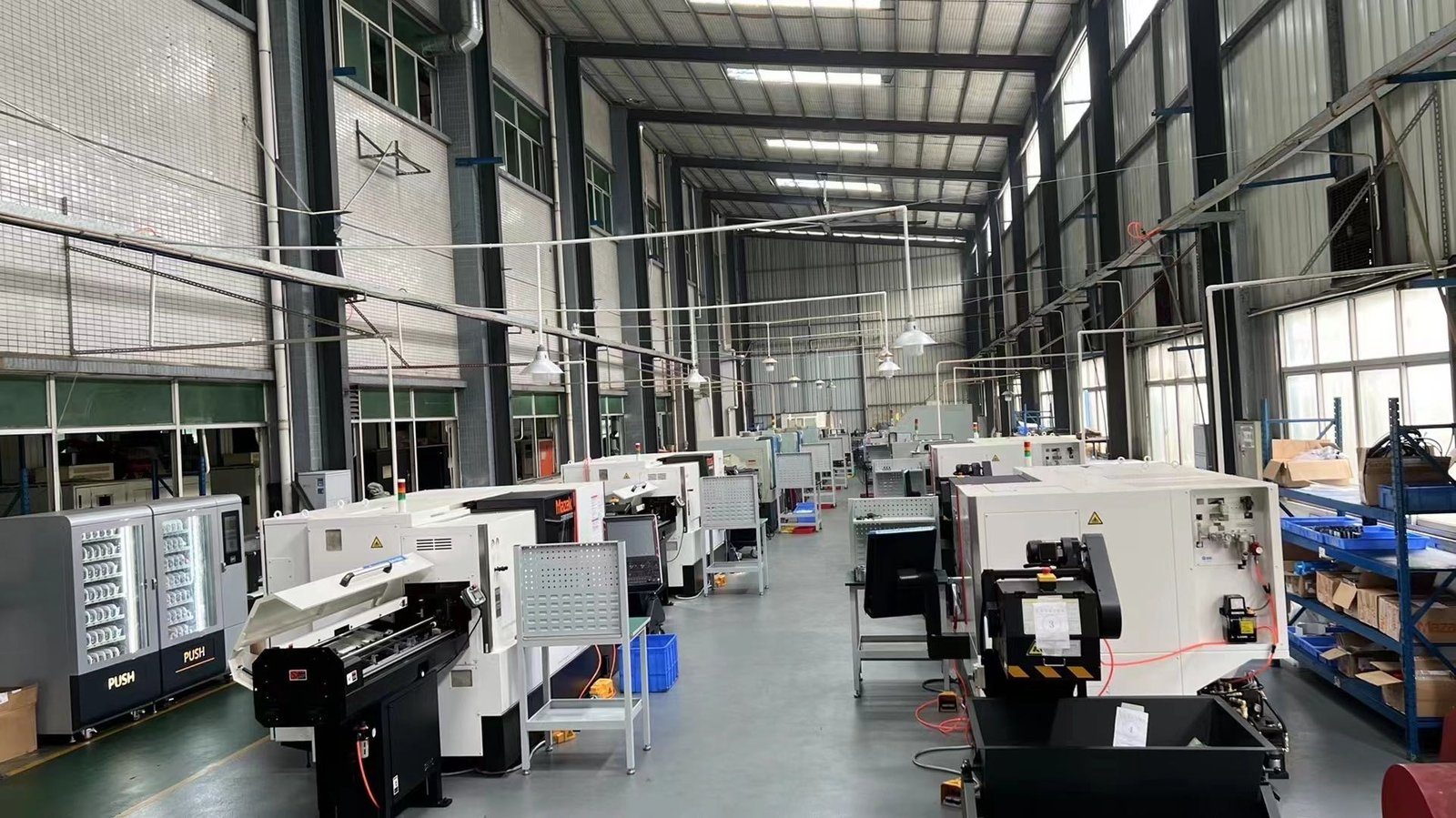
If you ask for capability evidence, you deserve a specific answer. This facility operates 100+ CNC machines across 6,800 m2 in Dongguan, China, staffed by 100+ people. The machines, listed by category:
- 5-axis machining centres (10+) - Mazak VARIAXIS I-600 (510/910/510 mm travel, 12,000 rpm, 22 kW, 71.6 N·m, 30-tool BT40) and Mazak INTEGREX I-250H S (B-axis 0.0001°, 24 kW, 124 N·m, 38-tool HSK-A63). Set up for compound-angle parts, single-setup multi-face prismatic work, and aerospace fittings where datum transfer loss is unacceptable.
- 3-axis / 4-axis machining centres (50+) - Brother SPEEDIO S500Z2N / S700Z2N (10,000 rpm, 14/21-tool ATC, 0.7 s tool-to-tool, Z-axis 2.2 G) and Mazak VCE-430A L / VCE-570C L (10,000 rpm, 118 N·m, 24-tool ATC). Set up for prismatic parts, plates, brackets, housings.
- Swiss-type turning centres (10+) - Citizen Cincom A20-3F7 (Φ20 mm, 10,000 rpm), TSUGAMI B0206-III / B0205-III (Φ20 mm, 0.1 µm), STAR SR-32JII / SR-32J Type N (Φ32 mm, 8,000 rpm). Set up for long, slender rotational parts at ±0.002 mm.
- CNC turning centres (20+) - HEADMAN T70M/1250 (720 mm swing, 117 mm bore, 3,000 rpm, BMT75 12-station turret). Set up for shafts, bushings, flanges up to ±0.002 mm.
- Wire EDM (5+) - Sodick AQ535L (550/350/300 mm travel, ±20° taper, 800 kg workpiece). Set up for hardened tool steel, internal splines, sharp internal corners that milling cannot reach.
- Inspection: Hexagon CMM + 20+ gauges - Hexagon CMM for coordinate measurement, plus vision system, profilometer, hardness tester, coating thickness gauge, XRF for material verification. The 10:1 rule (gauge 10x more accurate than the band) is applied to every feature.
- Machine highlights - VARIAXIS I-600: one-setup multi-face 5-axis + MAZA-CHECK auto-calibration; INTEGREX I-250H S: DONE-IN-ONE mill-turn, B-axis 0.0001° + Ai thermal shield; SPEEDIO S500Z2N / S700Z2N: Z-axis 2.2 G + 0.7 s ATC; Swiss-type: guide-bush switchable + 0.1 µm resolution.
Tolerance bands: ±0.003 mm milled, ±0.002 mm turned, ±0.002 mm ground or wire-cut. Capability indices: Ppk >= 1.67 at the initial study; Cpk >= 1.33 ongoing in production.
Certifications: ISO 9001:2015 (116024/A/0001/UK/En) · IATF 16949:2016 (131941/A/0001/SM/En, design clause 8.3 excluded) · ISO 14001:2015 (116024/B/0001/UK/En), held by Dongguan Zhuohang Ltd (USCC 91441900MA4UWT6X39, since 2005).
Service area: we supply Austria, Belgium, the Czech Republic, Denmark, France, Germany, Greece, Hungary, Ireland, Italy, the Netherlands, Spain, Sweden and the United Kingdom in Europe; Brazil, Canada, Mexico and the United States in the Americas; China, Israel, Japan, Singapore and Sri Lanka in Asia; Australia and New Zealand in Oceania; and South Africa in Africa, with worldwide delivery from China.
Contact: Felipe Iglesias, [email protected], +86 13126536955.
Want a turning date you can plan around?
Send the drawing to [email protected] with material, quantity, and finishing, and ask for the milestone plan - bar date, machine start, first article, and ship date.
Frequently Asked Questions
How fast can a straightforward turned part be ready in 2026?
In short, With a complete drawing and a stocked bar grade, a simple part is typically ready at the factory in about one to three weeks at prototype quantity, before transit. Shops commonly publish three, seven, and thirty-day tiers for simple, standard, and complex work, but the exact date comes from the specific drivers - material wait, queue, finishing - not from the tier label.
Why does the machining step rarely set the delivery date?
In short, Because turning removes metal fast, so a simple part's cutting time is minutes, while the steps around it - the bar order, the queue ahead of your job, the finishing batch, and the freight - all move in days. A schedule built on spindle time will always come in optimistic; the calendar is written by the chain around the spindle.
What should a buyer send to keep the lead time short?
In short, A complete package in the first message: the drawing with the material grade, quantity, finish, and functional tolerances named. Every missing detail starts a question round, and question rounds consume days that never touch a machine.
How long does bar stock take to arrive for a turning order?
In short, Common grades in standard diameters - 6061-T6, 303 and 304 stainless, 12L14 steel - are usually local stock, a day or two from a distributor. Unusual diameters, specialty alloys, or certified material for a controlled program add days to weeks because they come from the mill through the distribution chain.
Which part features add the most calendar time?
In short, The ones that force a second operation or a second machine. A cross hole at a defined angle, a milled flat that must sit true to a datum, a keyway, or a grind each add a queue, and queues are where days accumulate.
How much time should be allowed for finishing a turned part?
In short, Finishing runs in batches, so count in days: a few for standard anodize or passivation, more for hard anodize or thickness-verified coatings, and extra if the work goes to an outside shop. Heat treatment adds time too, because the part often needs rough turning, treatment, and a final pass on the critical surfaces.
Do prototypes and production runs need different schedules?
In short, Yes, and the difference is the approval gate. A prototype runs from order to first article and inspection; a production run starts after the prototype is approved, adds bar for the full quantity, re-releases the setup, and inspects the whole lot.
Should the first shipment go by air or sea?
In short, For a first article, air is the rational choice - it closes the design loop in days instead of weeks and lets the production decision happen sooner. For repeat production, sea freight on a regular schedule is the economic default once inventory covers the transit.
Standards referenced on this page
- ASTM A582/A582M-12 — Standard Specification for Free-Machining Stainless Steel Bars
- ASTM A276/A276M-17 — Standard Specification for Stainless Steel Bars and Shapes
- ISO 9001 — Quality management systems — Requirements