
A turned part is the most transparent piece of machining economics you will ever price, because its geometry is rotation and its process is one tool cutting that rotation. That transparency is your advantage: a CNC turning quote can be read line by line - bar, cycle time, setup, tooling, finishing - and each line can be checked against the drawing. In 2026 the structure of those lines is stable, and if you can read them, you can compare any two quotes and build a budget that survives the first invoice.
This guide walks through the lines in the order a shop builds them. It explains where the material money goes, what makes cycle time climb, which drawing features quietly add operations, what quantity really does to the price, and why the number to manage is not the unit price but the total cost of ownership of the part in your assembly.
What are you actually paying for when you buy a turned part?
A turning quote is a process plan with prices attached. The person who built it read your drawing, decided how the bar would be held, which tools would touch each feature, how many setups the part needs, and what inspection the critical diameters require - and priced those decisions. Read a quote as that plan, and you can see where the money went and where it could be removed.
The lines repeat on every honest quote. Bar material at the bought diameter and grade. Setup and programming, paid once per order. Cycle time on the machine, set by the material and the feature count. Tooling for profiles and threads that are not standard. Secondary operations for features the lathe cannot reach in its primary pass. Finishing, inspection, and the documentation that proves the diameters. Every quote is those lines in some order.
The same drawing quoted by two shops differs because the plans differ - a different number of setups, a different reading of a tolerance, a different decision to run a feature on a driven tool or a second machine. That is why the most useful reply to a quote request is not the total but the plan: the process note that tells you what the shop intends to do and where the cost is concentrated.
How does the bar economy work - and what does it cost you?
Turning starts from a round bar, and the bar economy has one rule that surprises most buyers: you pay for the stock, not the part. A part with a 25 mm OD is machined from a 25 mm (or larger) bar, and everything removed between the bar surface and the finished profile is metal you bought once and the shop chips away. Utilization - the share of the bar that survives as the part - is a real cost line, and it is decided by the starting diameter on the drawing.
Material price follows grade. Aluminum bar is the low-cost baseline and cuts at speeds that keep the cycle short. Brass costs several times more per kilogram but machines so well that it can still win on total cost for high volumes of small parts. Free-machining steels and 303 stainless sit above aluminum, 304 and 316 higher still, and titanium and the nickel alloys at the top of the range - bought slowly, cut slowly, and priced accordingly.
Two choices keep this line honest. Specify the exact grade so the shop is not free to pick an easier-to-cut substitute that fails your service. And ask what bar diameter the quote assumes - if the drawing allows a smaller starting bar or a tube, the material line falls without a single tolerance changing. Utilization is a design decision before it is a shop decision.
What makes cycle time climb - and with it the price?
Cycle time is where turning costs are really made, and it is driven by three things: the material, the geometry, and the number of features. Material sets the cutting speed - aluminum allows fast passes, stainless cuts at a fraction of that speed, titanium lower still - and geometry sets how many passes the material needs. Every diameter step, shoulder, groove, and thread adds a pass, and passes add seconds that multiply across the quantity.
Long thin sections and deep bores are the geometry that inflates cycle time fastest, because both fight deflection and force slow, careful cutting. A slender shaft cannot be rushed - the tool pushes it away and the pass goes wrong - so the shop drops the speed and takes lighter cuts. A deep bore fights chip evacuation and tool rigidity. These are not negotiable minutes; they are the physics of turning a long, thin column of metal.
Feature count is the buyer-controlled variable. Each unnecessary step, each extra shoulder that serves no function, each diameter held tighter than the assembly needs adds cycle time and inspection. When you review a drawing for cost, count the features and ask which ones function - the ones that do not are paying passes that never help the part work.
When does the drawing itself inflate the quote?
Drawings inflate quotes in predictable ways, and all of them are visible before the quote is written. The largest is tolerance density: a drawing that holds every diameter to a precision band converts a routine turning job into an inspection project, because every controlled diameter must be measured and documented under the quality system rather than checked. Precision turning holds ±0.002 mm and grinding ±0.002 mm, with capability targets such as Ppk ≥ 1.67 at the initial study on key characteristics and Cpk ≥ 1.33 on general characteristics. Capability is reported per characteristic: every report names the feature, its tolerance band, the sample size, the sigma method, and the study window. - but those bands cost their own cycle time and measurement, and they should sit only where the assembly needs them.
The second inflator is secondary geometry. A cross hole at a compound angle, a milled flat with a tight orientation, a keyway with a narrow width - each pulls the part out of the simple turning flow and into a second setup or a second machine. Driven tools on a turn-mill center absorb many of these in the primary setup, but every feature the primary pass cannot produce is a feature that adds handling and a hand-off.
The third is ambiguity. A drawing with no material grade, no finish, and no statement of which diameters are critical forces the shop to price the uncertainty - and the price of uncertainty is margin. A complete drawing is not a courtesy; it is a discount, because it lets the supplier quote what you need instead of what it fears you mean.
What do setups, tooling, and batch size do to the unit price?
Setup and programming are fixed costs paid once per order, and batch size decides how thinly they spread. A one-piece order carries the entire setup on that single part, which is why prototypes look expensive. At twenty pieces the setup is spread twenty ways; at two hundred it is nearly invisible. The same logic covers tooling: standard inserts are cheap and shared, while a special form tool or a profile cutter for your geometry is a line that someone pays once.
Bar-fed automation changes the quantity math on turning. A bar feeder lets a machine run a long batch unattended, and configuring that setup is only worth it at volume - which is why a simple pin at ten thousand pieces can reach a unit price a hundred-piece order could never approach. The same part, same tolerance, different quantity, different process economics: the shop picks the process the quantity justifies.
Quantity discounts therefore flatten once fixed costs are spread and bar and cycle time dominate. Beyond that point, ordering more lowers the unit price on paper while raising your inventory cost and obsolescence risk. Quote the quantity you actually plan to consume, let the fixed costs amortize over it honestly, and spend the saving where it functions.
Where does finishing sit in the total-cost stack?
Finished turned parts rarely ship bare, and the finishing lines are where surprises hide. Anodizing, passivation, plating, and bead blasting each add a process with its own batch economics: standard clear anodize or passivation is a modest per-piece line once the tank runs, while hard anodize and any thickness-verified coating cost more and carry more verification. Plating may travel to an outside specialist whose batch calendar adds both days and margin.
The quote discipline is to name the finish precisely and confirm what is included. "Anodized" can mean clear, dyed, or hard, and the spread is large; "passivated" can mean a quick dip or a certified process with testing. A unit price that stops at the machined surface is not comparable to one that includes finishing, and comparing them produces a false saving.
Read finishing as part of the total cost of ownership rather than a line to cut. A coating that prevents corrosion, galling, or wear is cheaper than the failure it prevents, and a finish omitted to save a dollar per part can cost a hundred in the field. The question is not whether finishing is expensive but whether the part needs it - and the service environment answers that.
What is total cost of ownership, and why is it the real number?
The unit price is the visible number; the total cost of ownership is the number that decides whether a sourcing decision was good. TCO adds everything the part costs you between the first quote and the end of its service: the price, the freight, the duty, the incoming inspection, the rework and scrap when a batch drifts, the delay cost when a delivery slips, and the field cost when a part fails in service. A quote that is a few percent cheaper but arrives late or drifts out of spec is not cheaper at all.
On turned parts, TCO is decided mostly by three things. Quality cost, because a turned diameter that drifts can fail an assembly and the failure is found downstream. Delay cost, because a shaft that arrives late stops the line or the launch. And material risk, because a part made from the wrong grade - a 304 where 316 was ordered - can fail in service with no dimensional report ever catching it. The cheapest quote optimizes the wrong variable if it skips these.
That is why the supplier matters in the TCO equation. A certified shop with documented inspection - ISO 9001:2015 and IATF 16949:2016 systems, CMM reports with the parts, incoming bar verified against the certificate - is pricing the quality controls into the quote. Buying those controls as part of the price is usually cheaper than arranging them yourself after the parts arrive.
How do you build a 2026 budget and compare quotes fairly?
Build the budget from the process, not from a guess at the total. Fix the geometry and its functional features, name the grade and bar condition, and decide which diameters are critical. Then ask each shortlisted shop for the same thing: an itemized quote stating the bar diameter, the setup count, the cycle time, the tooling, the finishing, and the inspection it will provide. A quote that states its assumptions is comparable; one that hides them is a number looking for a justification.
When the quotes arrive, normalize them line by line before comparing totals. Confirm every offer is for the same material, the same number of setups, the same tolerance interpretation, the same finish, and the same documentation. Then read the process notes: the shop that flags a bar-size saving, questions a functional tolerance, or explains its routing is engineering your cost down, while the silent quote is pricing your ambiguity up.
Finally, put the numbers in TCO terms. Add the freight under the agreed Incoterm, the inspection you will do or receive, and the schedule risk each supplier carries. The quote that wins on TCO at your quantity and your quality requirements is the one to build the budget around - and a budget built that way holds across reorders, because it is built on the process, and on turning, the process is the price.
What this shop actually runs
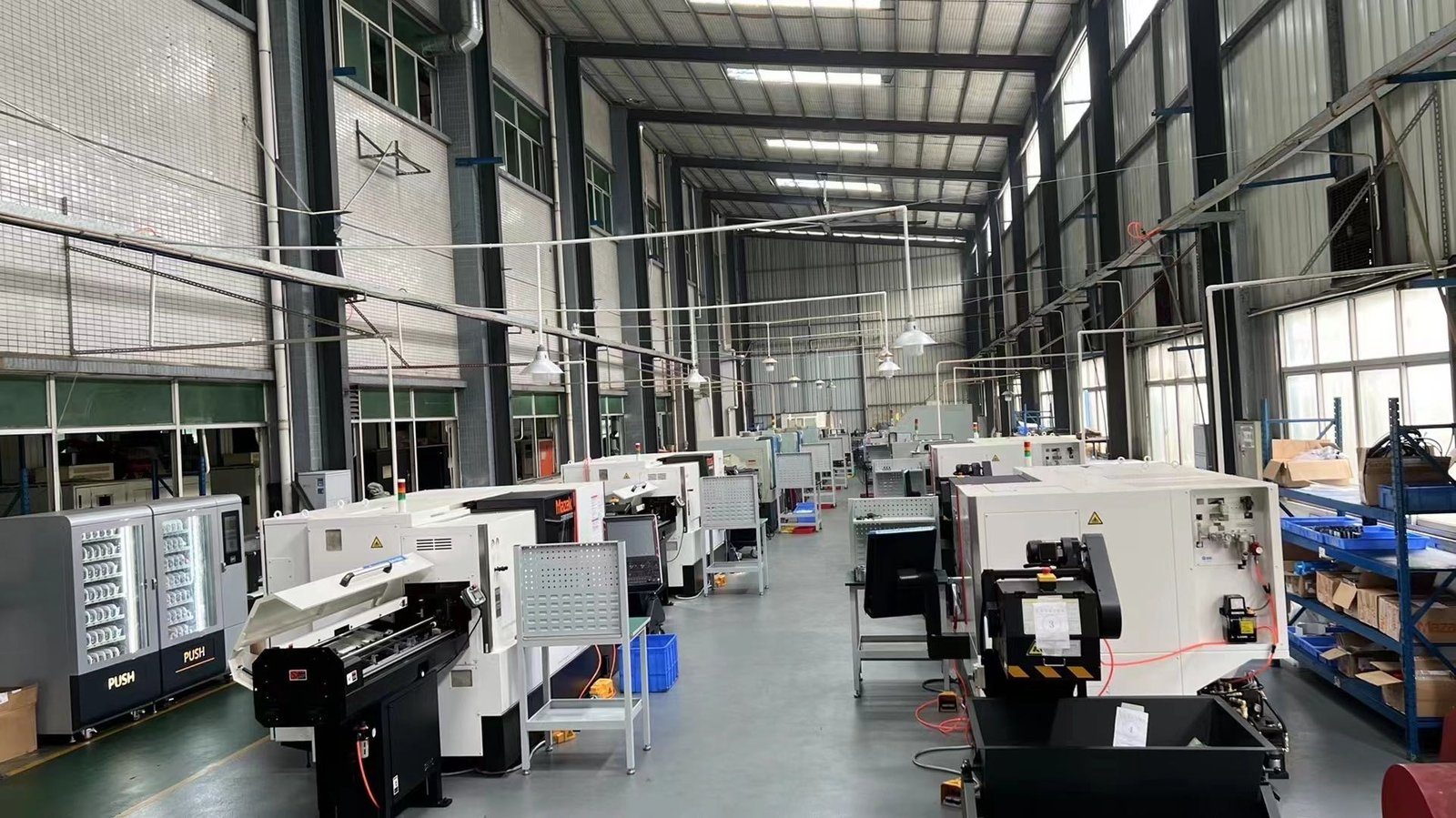
If you ask for capability evidence, you deserve a specific answer. This facility operates 100+ CNC machines across 6,800 m2 in Dongguan, China, staffed by 100+ people. The machines, listed by category:
- 5-axis machining centres (10+) - Mazak VARIAXIS I-600 (510/910/510 mm travel, 12,000 rpm, 22 kW, 71.6 N·m, 30-tool BT40) and Mazak INTEGREX I-250H S (B-axis 0.0001°, 24 kW, 124 N·m, 38-tool HSK-A63). Set up for compound-angle parts, single-setup multi-face prismatic work, and aerospace fittings where datum transfer loss is unacceptable.
- 3-axis / 4-axis machining centres (50+) - Brother SPEEDIO S500Z2N / S700Z2N (10,000 rpm, 14/21-tool ATC, 0.7 s tool-to-tool, Z-axis 2.2 G) and Mazak VCE-430A L / VCE-570C L (10,000 rpm, 118 N·m, 24-tool ATC). Set up for prismatic parts, plates, brackets, housings.
- Swiss-type turning centres (10+) - Citizen Cincom A20-3F7 (Φ20 mm, 10,000 rpm), TSUGAMI B0206-III / B0205-III (Φ20 mm, 0.1 µm), STAR SR-32JII / SR-32J Type N (Φ32 mm, 8,000 rpm). Set up for long, slender rotational parts at ±0.002 mm.
- CNC turning centres (20+) - HEADMAN T70M/1250 (720 mm swing, 117 mm bore, 3,000 rpm, BMT75 12-station turret). Set up for shafts, bushings, flanges up to ±0.002 mm.
- Wire EDM (5+) - Sodick AQ535L (550/350/300 mm travel, ±20° taper, 800 kg workpiece). Set up for hardened tool steel, internal splines, sharp internal corners that milling cannot reach.
- Inspection: Hexagon CMM + 20+ gauges - Hexagon CMM for coordinate measurement, plus vision system, profilometer, hardness tester, coating thickness gauge, XRF for material verification. The 10:1 rule (gauge 10x more accurate than the band) is applied to every feature.
- Machine highlights - VARIAXIS I-600: one-setup multi-face 5-axis + MAZA-CHECK auto-calibration; INTEGREX I-250H S: DONE-IN-ONE mill-turn, B-axis 0.0001° + Ai thermal shield; SPEEDIO S500Z2N / S700Z2N: Z-axis 2.2 G + 0.7 s ATC; Swiss-type: guide-bush switchable + 0.1 µm resolution.
Tolerance bands: ±0.003 mm milled, ±0.002 mm turned, ±0.002 mm ground or wire-cut. Capability indices: Ppk >= 1.67 at the initial study; Cpk >= 1.33 ongoing in production.
Certifications: ISO 9001:2015 (116024/A/0001/UK/En) · IATF 16949:2016 (131941/A/0001/SM/En, design clause 8.3 excluded) · ISO 14001:2015 (116024/B/0001/UK/En), held by Dongguan Zhuohang Ltd (USCC 91441900MA4UWT6X39, since 2005).
Service area: we supply Austria, Belgium, the Czech Republic, Denmark, France, Germany, Greece, Hungary, Ireland, Italy, the Netherlands, Spain, Sweden and the United Kingdom in Europe; Brazil, Canada, Mexico and the United States in the Americas; China, Israel, Japan, Singapore and Sri Lanka in Asia; Australia and New Zealand in Oceania; and South Africa in Africa, with worldwide delivery from China.
Contact: Felipe Iglesias, [email protected], +86 13126536955.
Want an itemized number for your turned part?
Send the drawing to [email protected] with material, quantity, and finishing, and ask for the line-item quote with bar diameter, setup count, and cycle time stated.
Frequently Asked Questions
What does a turned part typically cost in 2026?
In short, There is no honest single answer without a drawing, because diameter, length, material, and quantity decide the number. As planning bands at small quantity, a straightforward pin or bushing in 6061 or 303 usually lands in the single digits to mid-teens of USD per piece, while a multi-diameter shaft with cross features and controlled tolerances climbs well beyond that.
Why do two shops quote the same turned part very differently?
In short, Because the scope differs more than the metal. Compare the bar grade and diameter each assumed, the number of setups, whether cross holes and flats are priced in or priced later, how the critical diameters were interpreted, the finishing, and the inspection paperwork.
How much of a turned part's price is the bar itself?
In short, It depends on utilization. Turning starts from a bar larger than the part and the removed material is scrap, so the material line is the bought bar, not the part weight.
Is round work cheaper to machine than prismatic work?
In short, Generally yes, for genuinely round features. A lathe removes metal fast with one cutting edge and one setup can produce the full diameter profile, whereas milling the same round from a block burns machine time on wasted material.
What does a tight diameter tolerance add to the price?
In short, It adds finishing passes and measurement. Precision turning holds ±0.002 mm and grinding reaches ±0.002 mm, with capability targets such as Ppk ≥ 1.67 at the initial study on key characteristics and Cpk ≥ 1.33 on general characteristics.
Do bigger order quantities always mean a lower unit price?
In short, Up to the point where fixed costs are fully spread. Setup, programming, and first-article inspection divide across the run, so the unit price falls as quantity rises, then flattens once bar and cycle time dominate.
What costs typically sit outside the quoted unit price?
In short, Secondary operations that are not itemized, finishing quoted as an option rather than included, special tooling for unusual profiles, extra inspection documentation, freight under the agreed Incoterm, and the cost of the payment terms. A unit price means little until those lines are stated; a line-item quote is the only comparable one.
What is the quickest way to reduce the cost of a turned part?
In short, Simplify what the drawing demands. Name the grade and bar condition, tolerance only the diameters that function, keep the number of shoulders and steps purposeful, and specify the finish and inspection in the RFQ.
Standards referenced on this page
- ASTM A276/A276M-17 — Standard Specification for Stainless Steel Bars and Shapes
- ASTM B211/B211M-19 — Standard Specification for Aluminum-Alloy Rolled or Cold Finished Bar, Rod, and Wire
- ISO 9001 — Quality management systems — Requirements