
On a lathe, the material choice is not a background decision - it is the decision. The bar spinning in the chuck sets the cutting speed, the feed, the finish, the insert life, and the cycle time, and those five things write the quote. Then, after the part ships, the same bar sets the corrosion resistance, the stiffness, the weight, and the service life. Aluminum bar and stainless bar occupy opposite ends of both stories, and a buyer who can read the difference can make the call on the drawing instead of inheriting it from a supplier's preference.
The quick filter for turned parts: if the part must be light, cheap, or cosmetic and lives indoors at moderate temperature, aluminum is the default and stainless is a premium with no payoff. If the part sees moisture, chemicals, heat, repeated assembly, or a safety function, stainless is the default and aluminum is a risk in a cheaper package. The grade selection below decides the details after that filter.
Why is machinability the whole game on a lathe?
A mill spends much of its time positioning, fixturing, and reaching; a lathe spends its time cutting. The tool is almost always in the metal, so the material's machinability - how fast it can be cut, how cleanly the chip breaks, how gently it treats the insert - sets the cycle time almost directly. A bar that cuts at three times the speed of another makes the same part in a third of the machine time, and the quote follows the machine time.
Chip control is the detail that separates turning materials. A turned part produces a continuous chip that must break and clear the tool, and the alloy decides whether it does. Aluminum and 303 stainless break chips cleanly and predictably. 304 and 316 fight the tool, build up on the cutting edge, and need controlled feeds to manage the chip. The supplier's skill at managing that behavior shows up in the cycle time and the price.
That is why the grade belongs on the drawing. A shaft specified only as "aluminum" or "stainless" invites the shop to pick the grade it finds easiest to turn, which may not be the grade your service needs. The material decision is a function decision wearing a machinability costume, and the buyer who owns the design should make it.
The aluminum bar story: speed and economy
Aluminum bar is the economical default for round parts for one dominant reason: it is fast. High cutting speeds, clean chips, low insert wear, and a bright machined finish mean short cycle times and low tooling cost, which is why aluminum dominates the turned parts that ship in volume - pins, spacers, fittings - and every prototype that does not need stainless properties. At about 2.7 g/cm³ it is a third of steel's weight, and it anodizes, which gives designers a colored, wear-resistant surface for the cost of a finishing step.
The grade matters within the family. 2011 is the free-machining aluminum built for the lathe: it cuts fast and breaks chips beautifully, and it is the economical choice for volume turned parts where cosmetics are not the driver. 6061-T6 is the general-purpose grade with better corrosion resistance and weldability, chosen when the part carries machined features or must match a 6061 assembly. 7075-T6 is the high-strength aluminum for loaded parts, with a costlier bar and a harder cut.
The limits are just as clear. Aluminum does not resist salt, acids, or galvanic contact without protection, its stiffness is a third of steel, and long slender aluminum shafts deflect under load. When the drawing needs a long unsupported span or a corrosion-exposed fitting, aluminum is the wrong family regardless of how cheap and fast it turns.
The stainless bar story: corrosion and strength
Stainless bar earns its premium in the service aluminum cannot provide. Where a turned part meets moisture, chemicals, food, or marine air, the chromium oxide layer protects it without a coating that can wear or scratch. Where a part is cleaned, sterilized, or cycled hard, stainless survives the routine. Where a fitting or shaft carries pressure or a safety function, the stiffness and toughness of steel are the engineering default that no aluminum geometry can fully replace.
The numbers behind that confidence are simple. At about 7.9 g/cm³ stainless weighs nearly three times as much as aluminum, and its elastic modulus of roughly 200 GPa against aluminum's 69 GPa makes a stainless shaft of the same geometry about three times stiffer. That stiffness is what stops long shafts from flexing in service - and it is the same stiffness the shop must manage during cutting, because the workpiece pushes back harder and builds more heat.
The cost is visible on the quote. Stainless bar costs several times more than aluminum per kilogram, cutting speeds fall to a fraction, and inserts wear faster, so the same turned part in stainless typically prices at a meaningful multiple of the aluminum version. The buying discipline is to pay for those properties only where the service requires them, and to never save money on a material that will fail in the field.
Reading the grade labels: which bar goes on the drawing?
The grade labels carry the whole decision, and each one has a job. On the aluminum side, 2011 is the screw-machine grade for high-volume economical parts, 6061-T6 is the balanced general-purpose choice, and 7075-T6 is the high-strength option for loaded components. On the stainless side, 303 is the free-machining grade that dominates turned fittings and shafts, 304 is the general corrosion-resistant choice, 316 adds molybdenum for chlorides and marine service, and 17-4PH delivers high strength through a precipitation-hardening step after machining.
Each label changes the process and the price in a known way. 2011 turns faster than 6061 but anodizes with a less even tone. 7075 cuts harder and costs more than 6061 but carries roughly 80 percent more strength. 303 turns far better than 304 but resists corrosion a little less. 316 costs more and cuts slower than 304 but survives salt and chemicals that pit it. 17-4PH machines in the soft condition and ages to roughly 1170 MPa yield, which is why it carries the high-strength round parts in aerospace and valve work.
Write the full label - grade and condition - on the drawing. "6061-T6" and "6061-T6511" are different materials for machining and stress purposes; "17-4PH" without a condition leaves the heat-treatment step undefined. The label is the contract between the design intent and the bar that arrives at the machine, and a complete label is the cheapest insurance in the sourcing process.
What does the material do to tolerances and surface on a turned part?
Tolerance behavior differs in how much effort a number costs, not in whether the number is reachable. Precision turning holds ±0.002 mm and grinding ±0.002 mm, with capability targets such as Ppk ≥ 1.67 at the initial study on key characteristics and Cpk ≥ 1.33 on general characteristics. Capability is reported per characteristic: every report names the feature, its tolerance band, the sample size, the sigma method, and the study window as the quality system documents, in both families. In aluminum, a critical diameter is mostly a stable setup and a good finishing pass, because the material cuts predictably and does not move between the machine and the gauge. In stainless, the same diameter must survive thermal growth during cutting and the work-hardened layer from the previous pass, so it takes controlled feeds and sometimes a finish pass with a fresh insert.
Surface finish follows the same pattern. Aluminum turns bright and consistent, and roughness requirements on cosmetic parts are met with routine passes. Stainless reaches the same Ra with more care and more insert changes, and a very fine finish may need a secondary operation. If the drawing names a roughness value, the material choice determines how much effort the finish costs - and a finish that is routine in one family can be a project in the other.
Threads add a third consideration. Internal threads in aluminum gall and strip under repeated assembly, which is why aluminum parts that get assembled often carry stainless threaded inserts. Stainless threads resist galling but need correct tapping practice because the work-hardened hole wrecks taps. The material and the thread specification belong together on the drawing, because the two decisions interact.
Where do the two families differ in the quote and the schedule?
The quote difference is the machinability tax. A 6061 shaft can be roughed and finished in a fraction of the time the same shaft takes in 316, with less tool wear and fewer surprises, and that cycle-time gap is the real source of the stainless premium - not the bar price alone, but the machine minutes the material demands. The schedule difference follows the same line: stainless jobs take more machine time and more inspection care, which pushes their dates out relative to aluminum equivalents.
Bar sourcing also differs. Aluminum bar in common grades is broadly stocked and cheap to ship. Stainless is stocked in the common grades too, but a specific grade such as 316L in an unusual diameter, or any certified material for a controlled program, adds sourcing days that the schedule must absorb. Titanium and nickel alloys, when they appear, sit at the slow end of both the cost and the calendar.
Finishing splits the families cleanly. Aluminum parts go to anodize - clear, dyed, or hard - for color and wear resistance. Stainless parts get passivation or electropolishing, which are different operations with different costs and calendars. A buyer who assumes the finish from the other family's habit will misquote both the price and the lead time, so name the finish that fits the material.
A comparison table for turned parts
The decision is easier when the numbers sit side by side. For round parts, the comparisons that matter most are between the fast aluminum grades and the workhorse stainless grades:
| Property | 2011-T3 (Al) | 6061-T6 (Al) | 7075-T6 (Al) | 303 (SS) | 316 (SS) | 17-4PH H900 |
|---|---|---|---|---|---|---|
| Turning machinability | Excellent | Very good | Good | Good | Fair | Fair |
| Density (g/cm³) | 2.83 | 2.70 | 2.81 | 8.00 | 8.00 | 7.78 |
| Typical yield (MPa) | ~325 | ~276 | ~503 | ~240 | ~290 | ~1170 |
| Corrosion resistance | Moderate | Good with anodize | Moderate | Good | Excellent | Good |
| Typical role | Volume pins, fittings | General parts | Loaded parts | Turned fittings, shafts | Marine, chemical | High-strength shafts |
| Relative machined cost | Low | Baseline | Higher | ~2-3x baseline | ~2.5-3.5x baseline | Highest |
Property figures are standard published values; treat the cost row as a planning relationship, not a quote.
Read the table against the part's real service. A fitting that lives in washdown or salt spray is a 316 decision regardless of the machinability penalty. A shaft that carries load in a dry warm assembly is a 7075 or 17-4PH decision, set by whether corrosion or fatigue dominates the failure mode. A cosmetic spacer is a 2011 or 6061 decision, and stainless there is money spent on a service the part never sees.
Making the call on the drawing
Make the material decision before the quote and put the full grade and condition on the drawing. The label is the contract: "aluminum" invites substitution between grades with different costs and different service lives, and "stainless" does the same. Name the grade, the condition, and the specification the certificate must cite, and the quote you receive will describe the part you intend to buy.
Then test the assumptions behind the choice. If the part is weight-critical, check whether aluminum's stiffness passes the deflection calculation at the diameter you can afford. If it is corrosion-critical, name the environment - indoor air, salt spray, chemical washdown - because that sentence alone picks the grade. If the part is threaded and assembled repeatedly, plan the insert or the material change that prevents galling. Each of those checks is cheap on the drawing and expensive in the field.
None of this requires a metallurgist. It requires asking what the turned part does, where it lives, and what it costs to fail, and letting the answers pick the bar. A CNC turning shop can cut either family to the same drawing at the same precision; the alloy decision - and the money and risk attached to it - belongs to the buyer who owns the design.
What this shop actually runs
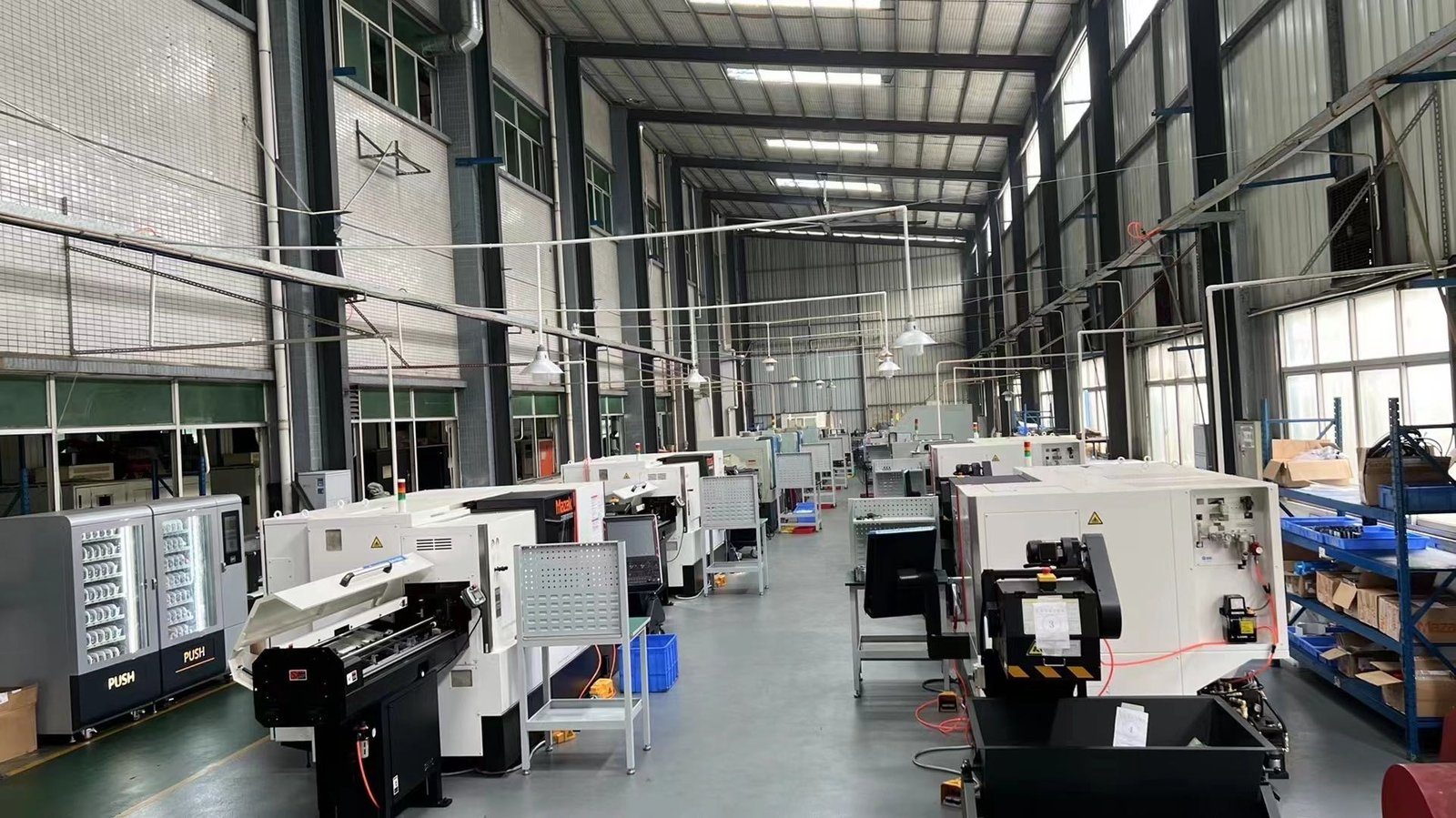
If you ask for capability evidence, you deserve a specific answer. This facility operates 100+ CNC machines across 6,800 m2 in Dongguan, China, staffed by 100+ people. The machines, listed by category:
- 5-axis machining centres (10+) - Mazak VARIAXIS I-600 (510/910/510 mm travel, 12,000 rpm, 22 kW, 71.6 N·m, 30-tool BT40) and Mazak INTEGREX I-250H S (B-axis 0.0001°, 24 kW, 124 N·m, 38-tool HSK-A63). Set up for compound-angle parts, single-setup multi-face prismatic work, and aerospace fittings where datum transfer loss is unacceptable.
- 3-axis / 4-axis machining centres (50+) - Brother SPEEDIO S500Z2N / S700Z2N (10,000 rpm, 14/21-tool ATC, 0.7 s tool-to-tool, Z-axis 2.2 G) and Mazak VCE-430A L / VCE-570C L (10,000 rpm, 118 N·m, 24-tool ATC). Set up for prismatic parts, plates, brackets, housings.
- Swiss-type turning centres (10+) - Citizen Cincom A20-3F7 (Φ20 mm, 10,000 rpm), TSUGAMI B0206-III / B0205-III (Φ20 mm, 0.1 µm), STAR SR-32JII / SR-32J Type N (Φ32 mm, 8,000 rpm). Set up for long, slender rotational parts at ±0.002 mm.
- CNC turning centres (20+) - HEADMAN T70M/1250 (720 mm swing, 117 mm bore, 3,000 rpm, BMT75 12-station turret). Set up for shafts, bushings, flanges up to ±0.002 mm.
- Wire EDM (5+) - Sodick AQ535L (550/350/300 mm travel, ±20° taper, 800 kg workpiece). Set up for hardened tool steel, internal splines, sharp internal corners that milling cannot reach.
- Inspection: Hexagon CMM + 20+ gauges - Hexagon CMM for coordinate measurement, plus vision system, profilometer, hardness tester, coating thickness gauge, XRF for material verification. The 10:1 rule (gauge 10x more accurate than the band) is applied to every feature.
- Machine highlights - VARIAXIS I-600: one-setup multi-face 5-axis + MAZA-CHECK auto-calibration; INTEGREX I-250H S: DONE-IN-ONE mill-turn, B-axis 0.0001° + Ai thermal shield; SPEEDIO S500Z2N / S700Z2N: Z-axis 2.2 G + 0.7 s ATC; Swiss-type: guide-bush switchable + 0.1 µm resolution.
Tolerance bands: ±0.003 mm milled, ±0.002 mm turned, ±0.002 mm ground or wire-cut. Capability indices: Ppk >= 1.67 at the initial study; Cpk >= 1.33 ongoing in production.
Certifications: ISO 9001:2015 (116024/A/0001/UK/En) · IATF 16949:2016 (131941/A/0001/SM/En, design clause 8.3 excluded) · ISO 14001:2015 (116024/B/0001/UK/En), held by Dongguan Zhuohang Ltd (USCC 91441900MA4UWT6X39, since 2005).
Service area: we supply Austria, Belgium, the Czech Republic, Denmark, France, Germany, Greece, Hungary, Ireland, Italy, the Netherlands, Spain, Sweden and the United Kingdom in Europe; Brazil, Canada, Mexico and the United States in the Americas; China, Israel, Japan, Singapore and Sri Lanka in Asia; Australia and New Zealand in Oceania; and South Africa in Africa, with worldwide delivery from China.
Contact: Felipe Iglesias, [email protected], +86 13126536955.
Unsure which bar grade fits the part?
Send the drawing to [email protected] with the service conditions and get a material recommendation alongside the quote.
Frequently Asked Questions
How much more does a stainless turned part cost than an aluminum one?
In short, For an equivalent part, expect on the order of two to three times the machined aluminum price before finishing. The gap comes from pricier bar, slower cutting, and shorter insert life, and it widens as part length and diameter grow because the cycle time grows with them.
Which is the better turning material, 6061-T6 aluminum or 304 stainless?
In short, There is no universal answer - there is a fit. Aluminum wins where weight, cost, and speed matter and the service is benign; stainless wins where corrosion, stiffness, or temperature matters.
Why is 303 stainless so common on turned parts?
In short, Because it was formulated for the lathe. The added sulfur makes the chips break short and stops them welding to the tool, which lets a shop run higher speeds with predictable results.
Can I prototype in aluminum and switch to stainless for production?
In short, You can, but budget a design pass and a first-article cycle in the final material. Stainless is nearly three times denser, machines with more heat, and behaves differently on thin walls and threads, so features validated in aluminum can shift in steel.
What happens if I just write 'aluminum' or 'stainless' on the drawing?
In short, You hand the material decision to the shop, and the shop will choose what it can cut cheapest, which may not serve your application. 'Aluminum' could become 2011 instead of 6061; 'stainless' could become 303 instead of 316.
Do both materials hold the same tolerances in turning?
In short, Yes, with different effort. Precision turning holds ±0.002 mm and grinding ±0.002 mm, with capability targets such as Ppk ≥ 1.67 at the initial study on key characteristics and Cpk ≥ 1.33 on general characteristics.
Which material turns to a better surface finish?
In short, Aluminum produces a bright, consistent turned finish with less effort, so cosmetic round parts default to it. Stainless reaches the same roughness with more insert changes and more care, and very fine finishes may need a grinding or polishing step.
Can stainless parts be anodized?
In short, No - anodizing is an aluminum process. Stainless is protected by its own oxide layer and gets passivation, electropolishing, or plating when a surface treatment is needed.
Continue reading: CNC Turning Service Stainless Steel · Cnc machine turning parts · Cnc turning aluminum parts factory
Standards referenced on this page
- ASTM B211/B211M-19 — Standard Specification for Aluminum-Alloy Rolled or Cold Finished Bar, Rod, and Wire
- ASTM A276/A276M-17 — Standard Specification for Stainless Steel Bars and Shapes
- ISO 9001 — Quality management systems — Requirements